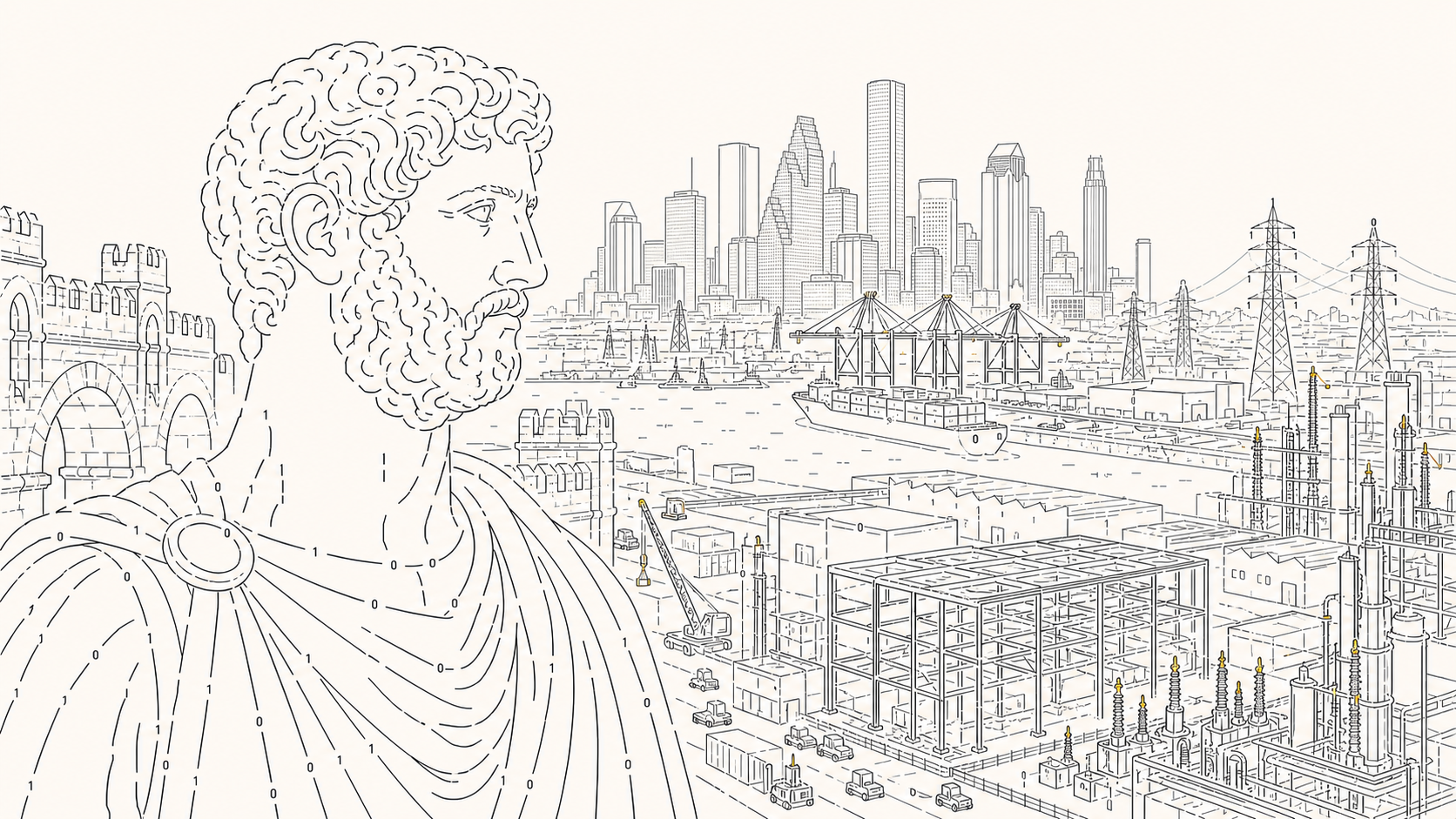
Shenzhen’s transformation borders on science fiction. When its special economic zone was created in 1980, it was still a small farming-and-fishing town. Today it is an 18-million-person metropolis of glass towers, often called China’s Silicon Valley and the global capital of hardware manufacturing. In 2025 alone, its factories produced 7.45 million civilian drones and nearly 195,000 industrial robots. Yet the output is less remarkable than what produces it: a system that moves an idea from sketch to prototype to mass production faster than any place on earth.
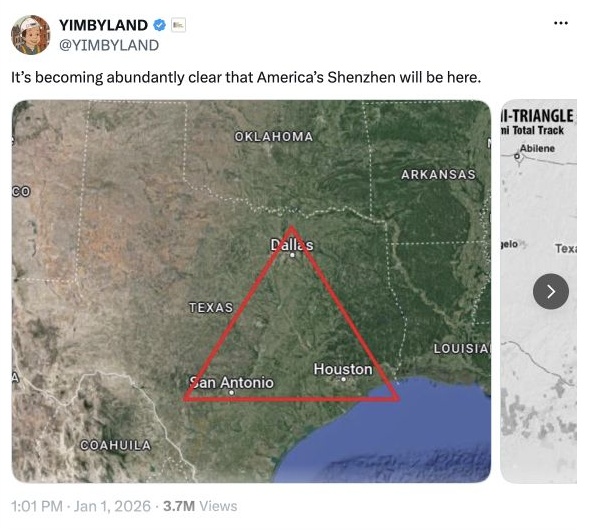
That capability has become a recurring fixation in America’s reindustrialization circles. On the first day of 2026, the X account @YIMBYLAND posted a map of the Texas Triangle (Houston, Dallas–Fort Worth, and Austin–San Antonio) with a single caption: “It’s becoming abundantly clear that America’s Shenzhen will be here.” The post captured the mood. Everyone wants to know which American city will become the next Shenzhen and which megaproject or policy will make it happen.
Is this even the right question or framing though? That framing treats Shenzhen as a standalone city we can copy, when Shenzhen has always been the production center of a larger regional machine. And it assumes the answer to Chinese industrial power is a smaller American version of the Chinese model.
What if America already has the pieces in place for something bigger and better? Those pieces are distributed across the Texas Triangle, where Houston serves as the manufacturing center, Austin as the incubator, and Dallas–Fort Worth as the capital and corporate layer. Austin supplies founders, venture capital, semiconductor and software depth, and a technical workforce enlarged by Silicon Valley transplants. Dallas–Fort Worth brings mature financial infrastructure, major-company headquarters, public-market expertise, and corporate customers. Houston is where the system becomes physical. It has the land, power, ports, suppliers, skilled trades, and operating culture required to take hard-tech companies from promising prototypes to industrial scale.
Until now, these Texas cities have mostly coexisted and competed rather than reinforced one another. Elon may have just tipped the first domino. SpaceX’s IPO expanded the financial capacity of one of Texas’s most consequential hard-tech companies, while its proposed Terafab project in Grimes County could place anchor demand at enormous scale on the Houston–Austin axis. Together, they could start the flywheel that turns Texas’s disconnected strengths into a self-reinforcing manufacturing system, one built not to imitate Shenzhen, but to outcompete it on American terms.
Let’s dive into it.
IShenzhen Was Never Just Shenzhen
The shorthand version of Shenzhen’s rise (fishing village, special economic zone, manufacturing miracle) reduces a beautifully executed regional industrial system to an oversimplified origin story. In August 1980, Beijing designated a largely rural border area north of Hong Kong as one of China’s first special economic zones. Shenzhen received unusual autonomy over investment, trade, land, and labor, while local authorities assembled industrial sites and built roads, water systems, and other connective infrastructure. Its location was deliberate. Hong Kong already possessed the capital, customers, management expertise, professional services, and export channels that the new manufacturing center could plug into.
The operating model became known as “front shop, back factory.” Hong Kong acted as the global storefront, supplying orders, finance, technology, management, legal and accounting services, and access to worldwide customers. Shenzhen and the wider Pearl River Delta were the factory, supplying land, labor, and production capacity; finished goods often returned through Hong Kong for packing and export. Cheap labor mattered, but it is not the enduring advantage. Repeated production drew suppliers close, trained workers, accelerated iteration, and turned manufacturing know-how into a regional asset. That regional logic persists: WIPO’s 2025 Global Innovation Index ranks Shenzhen–Hong Kong–Guangzhou, not Shenzhen alone, as the world’s leading innovation cluster.
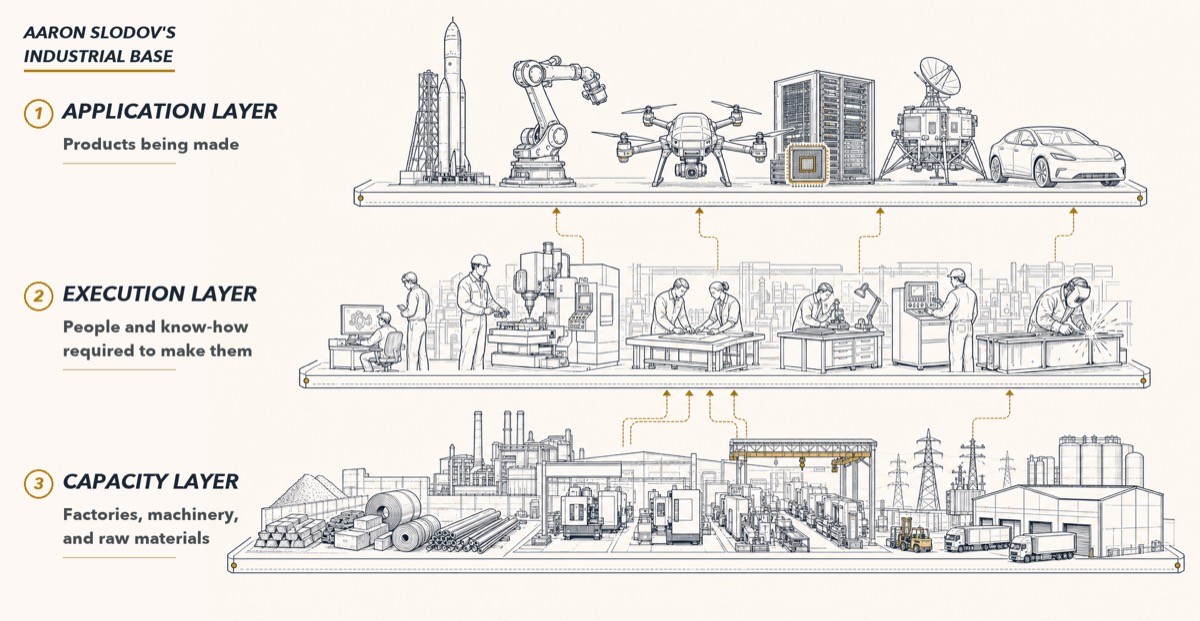
Atomic Industries co-founder Aaron Slodov offers a useful framework for why that system compounded. He divides the industrial base into three layers. First, the application layer: the products being made. Second, the execution layer: the people and the know-how required to make them. And third, the capacity layer: the factories, machinery, and raw materials underneath both. In the Hong Kong–Shenzhen system, the commercial front end connected products to capital and markets while Shenzhen and the wider Pearl River Delta accumulated execution and capacity. Capacity can be financed. Execution takes years of repeated production to build. Houston should be evaluated through the same functional lens: whether it can anchor a system in which each new factory makes the next one easier to build.
This is where Houston enters the comparison. Houston is not Texas’s Hong Kong; it is the region’s candidate production center. For the last thirty years, labeling Houston an “oil town” was a way to dismiss the city. Yet that label concealed an advantage. The region built an economy around financing, constructing, and operating complicated physical systems (think refineries) at enormous scale. That has left Houston with standing infrastructure and one of the country’s deepest supplier and skilled-trades bases for large industrial projects.
Houston is not pivoting to manufacturing. Houston already manufactures. The region has more than 7,000 manufacturing establishments and roughly 238,000 manufacturing workers. Manufacturing contributed more than $106 billion to the regional economy in 2023. The petrochemical complex along the Houston Ship Channel accounts for about 41 percent of U.S. base-petrochemical capacity. The Port of Houston is one of the nation’s largest ports for waterborne tonnage.
Houston has also spent a century training people to execute large industrial projects. Welders, pipefitters, instrumentation technicians, process operators, project managers, and logistics teams learned their trades in refineries, LNG terminals, and chemical plants. Advanced-hardware companies will need those workers, and their skills cannot be created overnight.
Houston does not need to invent an industrial culture. It needs to extend one that already knows how to build, commission, and operate expensive facilities under pressure. That inherited execution capacity is difficult to reproduce on demand.
IIThe Production Layer Is Arriving
Houston’s case cannot rest on industrial inheritance alone. The test is whether advanced-hardware companies are beginning to place real production inside the region.
They are.
Foxconn, the world’s largest contract electronics manufacturer, is placing a substantial bet. In 2025, a subsidiary acquired a roughly one-million-square-foot campus in northwest Houston for $142.1 million. Foxconn plans to invest $450 million in redeveloping the site and create as many as 600 jobs tied to AI-server manufacturing. Apple says its Houston operation began shipping advanced AI servers in 2025 and will expand server and logic-board production while adding Mac mini production in 2026.
In May, JPMorgan executive Doug Petno told the Houston Business Journal that Houston “has as good a chance as anywhere in the country” to become a focal point for the bank’s $1.5 trillion Security and Resiliency Initiative. The initiative is national, not a Houston allocation. But JPMorgan is the largest bank in the United States, and it does not name cities lightly.
CoStar’s senior director of market analytics for Houston, Itziar Aguirre, describes the pattern as “demand layering, not substitution.” Energy remains the foundation of Houston’s industrial market, she says, while AI and data-center-adjacent companies add “a new, highly intensive layer of demand on top of that.”
That is the pattern to watch. Advanced hardware is not replacing Houston’s industrial economy; it is attaching a new production layer to the execution and capacity already here. Foxconn and Apple do not make Houston a Shenzhen, but each project can deepen the supplier base, train more workers, and lower the cost and risk of the project that follows.
IIIA Texas Machine
An American manufacturing center can be centered in Houston without being contained by Houston. Austin is the Triangle’s incubator: founders, venture capital, semiconductor and software depth, and a technical workforce enlarged by migration from Silicon Valley. Austin is not manufacturing-light. It has serious semiconductor, electronics, and automotive capacity, but its base is narrower and more specialized than Houston’s. Austin can incubate more hard-tech companies than it can industrialize alone.
Dallas–Fort Worth supplies mature capital markets and corporate demand. Dallas is Texas’s business and financial-services hub; its financial-services cluster grew 22 percent from 2016 through 2023. DFW now has 24 Fortune 500 headquarters. Nasdaq Texas, a Texas-incorporated dual-listing exchange headquartered in Dallas, became fully operational in March 2026. Those institutions connect industrial founders to later-stage capital, public-market expertise, corporate buyers, and the management talent required to turn growing manufacturers into durable companies.
Houston is the production center. It contributes land, power, ports, suppliers, engineering and construction capacity, and a workforce trained to build and operate complicated physical systems. Austin incubates. Dallas capitalizes. Houston industrializes. Houston is the node that can combine the Triangle’s ideas and capital with the execution and capacity required to turn prototypes into a production system.
Together, the Texas Triangle’s metros may have an upper hand in integration: they operate inside one state and one domestic market, without customs, currency, or cross-border legal handoffs. The Triangle already holds more than 22 million people and nearly 80 percent of Texas GDP. Houston also begins with industrial infrastructure and operating talent that Shenzhen had to accumulate over time. But potential is not execution. The distances are greater, and Texas does not yet match Shenzhen’s supplier density or iteration speed.
The opportunity is not to recreate Shenzhen’s low-wage model. It is to reproduce its density of suppliers, skills, logistics, and rapid iteration while building a more diversified and resilient American system. This is not a contest among Texas cities. It is a division of labor.
IVThe Catalyst
Complementary assets do not become a cluster through proximity alone. A cluster needs anchor demand strong enough to pull suppliers into place and capital formation deep enough to finance the next generation. Elon may have just supplied both.
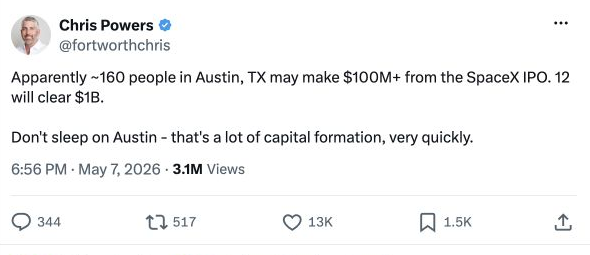
SpaceX’s IPO generated a historic $85.7 billion in gross proceeds. Impressive on its own, the larger consequence may be what the offering does to Texas’s hard-tech talent base: as liquidity reaches employees and early shareholders over time, experienced operators can become well-capitalized founders, angel investors, and early hires for the next generation of companies. Ahead of the offering, Fort Worth investor Chris Powers wrote, “Apparently ~160 people in Austin, TX may make $100M+ from the SpaceX IPO. 12 will clear $1B. Don't sleep on Austin - that's a lot of capital formation, very quickly.” Across SpaceX’s full Texas footprint, the combination of new wealth and hard-won operating experience could unleash a tsunami of new hard-tech companies.
The second catalyst is Terafab. SpaceX and Tesla have outlined an initiative, joined by Intel, with a long-term goal of producing one terawatt of compute hardware each year. Grimes County has executed tax-abatement and economic-development agreements for the planned site at the former Gibbons Creek power plant on the Houston–Austin axis. SpaceX’s filings also warn that specific participation, projects, timelines, and capital spending remain contingent. Even so, the signal matters: one of the world’s most experienced hard-tech operators chose Houston’s wider industrial orbit for manufacturing at extraordinary scale.
Terafab would not create Houston’s industrial system; but it could force the existing system to compound. A project of that scale would require machine shops, engineering firms, utilities, contractors, logistics providers, suppliers, capital, and skilled workers. That is the domino effect worth watching: not one factory saving a city, but one anchor project making the next ten factories easier to finance, staff, supply, and operate.
The argument
America does not need a smaller Chinese industrial model. It needs an American system that connects invention, capital, and scale without crossing a national border. Texas already has the nodes: Austin incubates, Dallas capitalizes, and Houston industrializes. Houston is the key because execution and capacity are the scarce inputs in American reindustrialization. Elon may have tipped the first domino, but a catalyst is not an outcome. The test is whether founders, investors, and builders use that anchor to form suppliers, train workers, and build the next ten factories. If they do, Houston will not merely become America’s next Shenzhen. It will become the manufacturing center of a system designed to outperform the model on American terms.